Sparse signal decomposition framework for one- and multi-channel biomedical and general time-series data using the Matching Pursuit and Orthogonal Matching Pursuit algorithms. For multi-channel signals, each channel is decomposed independently; atoms are not selected jointly across channels.
The package provides two native R decomposition implementations, MP-R and OMP-R, together with the optional external EMPI backend for high-performance MP decomposition.
Supported features:
omp_reference()Note:
The terms MP-R and OMP-R, with the suffix R, refer to the corresponding native R backends rather than to the algorithms themselves. The terms MP and OMP, without the suffix R, refer to the corresponding algorithms rather than to a specific implementation.
You can install the released version from CRAN with:
install.packages("MatchingPursuit")For Gabor-based decomposition, mp_omp_execute() provides
the high-level interface. It prepares the Gabor dictionary, selects
candidate atoms, performs MP or OMP decomposition, combines the
numerical results with Gabor metadata, and returns an object of class
"mp".
sig_file <- system.file("extdata", "sample1.csv", package = "MatchingPursuit")
signal <- read_csv_signals(sig_file)

out_mp <- mp_omp_execute(
  signal = signal,
  mode = "mp",          # use "omp" for Orthogonal Matching Pursuit
  n_nonzero_coefs = 50,
  verbose = TRUE
)

plot(out_mp, channel = 1)
If dictionary = NULL, an XML Gabor dictionary
specification is generated internally.
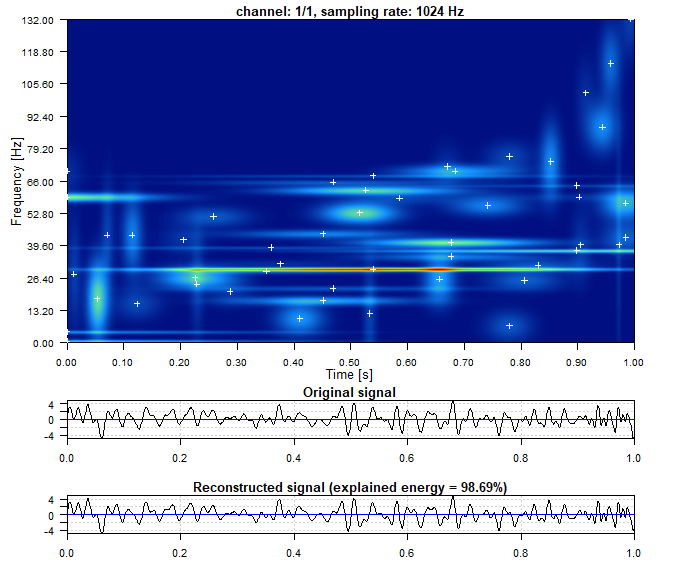
The time–frequency map below shows the energy distribution of the selected atoms. White crosses indicate the centers of individual time–frequency blobs, i.e. the atoms’ central time and central frequency coordinates. The panels below show the original signal and its reconstruction; in this example, the reconstruction explains 98.69% of the signal energy.
The native R implementations can operate directly on arbitrary user-defined dictionaries. Dictionary atoms are supplied as columns of a numeric matrix and are normalized internally to unit L2 norm.
N <- 256
t <- seq(0, 1, length.out = N)

dictionary <- cbind(
  sin(2 * pi * 5 * t),
  cos(2 * pi * 5 * t),
  sin(2 * pi * 10 * t),
  cos(2 * pi * 10 * t)
)

signal <- sin(2 * pi * 5 * t) + 0.5 * cos(2 * pi * 10 * t)

out <- omp_core(
  dictionary = dictionary,
  signal = signal,
  n_nonzero_coefs = 2
)

out$support
[1] 1 4

out$relative_residual_energy
[1] 1.000000e+00 2.012529e-01 4.867641e-32
In the example above, OMP correctly identifies atoms 1 and 4, corresponding to the 5 Hz sine and 10 Hz cosine components used to construct the signal. After two iterations, the residual energy is effectively zero.
EMPI is an optional external third-party backend used for high-performance Matching Pursuit decomposition and is distributed separately under its own license. It is not part of the MatchingPursuit package.
EMPI must first be installed using the empi_install()
function. The decomposition can then be performed using
empi_execute() and visualized using
plot().
sig_file <- system.file("extdata", "sample1.csv", package = "MatchingPursuit")
signal <- read_csv_signals(sig_file)

out_empi <- empi_execute(
  signal = signal
)

plot(out_empi, channel = 1)
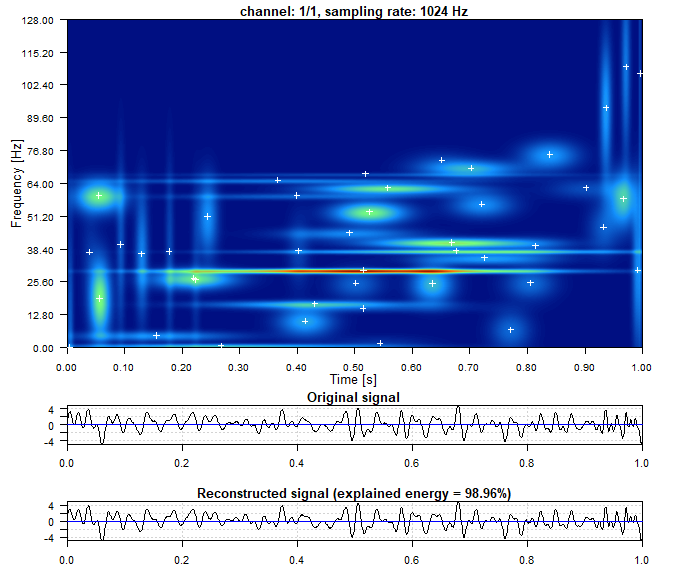
This example illustrates an EMPI-based decomposition and its time–frequency representation. The map reveals several localized components distributed across time and frequency, while the reconstructed signal closely follows the original waveform. In this case, the selected atoms explain 98.96% of the signal energy.
For small illustrative and validation examples,
omp_reference() provides a straightforward reference
implementation that follows the mathematical formulation of OMP
explicitly, including least-squares coefficient updates and residual
orthogonality checks.
ref <- omp_reference(
  dictionary = dictionary,
  signal = signal,
  n_nonzero_coefs = 2
)

ref$selected_atoms
[1] 1 4

ref$coefficients_original_dict
[1] 1.0 0.0 0.0 0.5

ref$normalized_reconstruction_error_original_dict
[1] 6.95e-16

ref$orthogonality
[[1]]
-5.03e-15

[[2]]
-5.30e-15  7.07e-15
The reference implementation recovers the exact coefficients of the original dictionary, while the near-zero reconstruction error and orthogonality values confirm the expected OMP properties.
The package provides three main decomposition routes.
| Route | Main functions | Purpose | Recommended use |
|---|---|---|---|
| General matrix-based MP/OMP | mp_core(),
omp_core() |
Sparse decomposition with arbitrary matrix dictionaries | General sparse decomposition and experimentation |
| Native R Gabor-based MP/OMP | mp_omp_execute() |
High-level Gabor-based MP or OMP decomposition | Time-frequency decomposition in R |
| External EMPI-based MP | empi_execute() |
Optimized Gabor-based Matching Pursuit | High-performance time-frequency decomposition |
The diagram below summarizes the three available
decomposition workflows and their relationship within the
package. Blue boxes denote R functions, whereas peach boxes represent
workflow components, inputs, or returned objects. The dashed red line
connects mp_omp_execute() in panel (a) with its internal
workflow shown in panel (b).
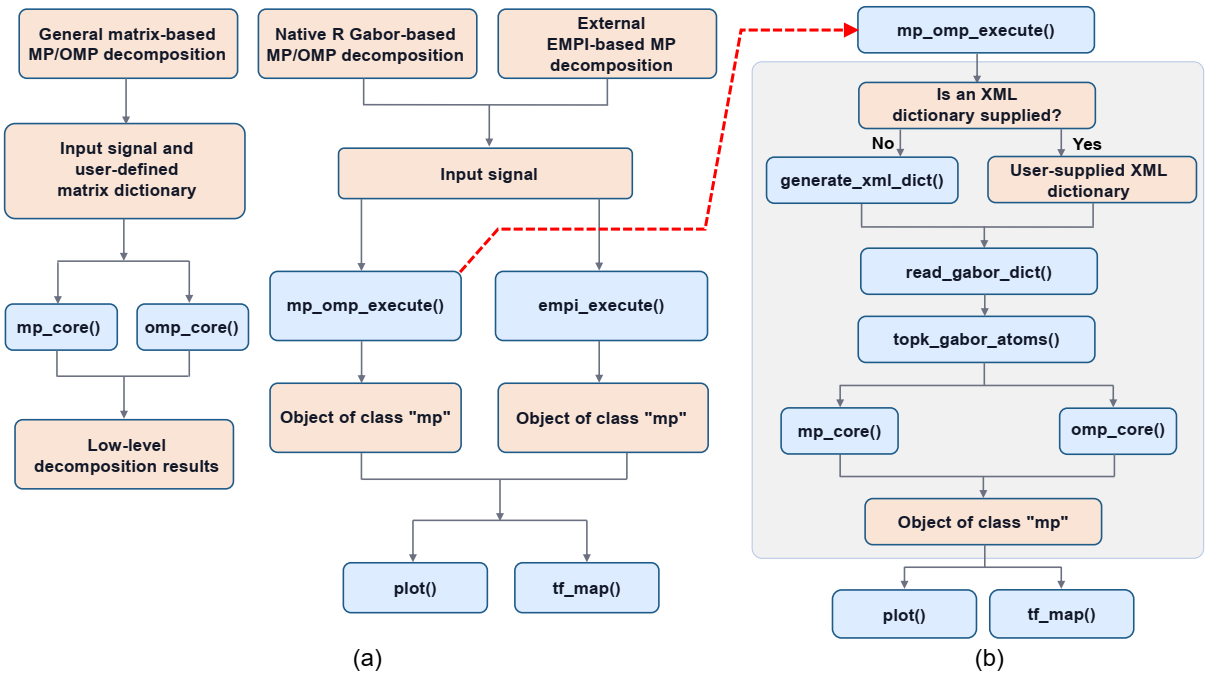
The general matrix-based MP/OMP workflow operates
directly on a user-defined numeric dictionary and input signal through
mp_core() or omp_core(). It is independent of
the Gabor-specific dictionary construction utilities and can therefore
be used with arbitrary matrix dictionaries. These functions return
low-level decomposition results, giving the user direct control over the
dictionary and the decomposition procedure.
The native R Gabor-based MP/OMP workflow,
implemented by mp_omp_execute(), provides a higher-level
interface for Gabor-based MP and OMP decomposition. It integrates
dictionary specification or generation, dictionary reading,
channel-specific atom preselection, decomposition with
mp_core() or omp_core(), and aggregation of
the results into an object of class "mp". If no XML
dictionary specification is supplied, generate_xml_dict()
creates one internally; otherwise, the user-provided XML file is used.
The specification is processed by read_gabor_dict(), after
which topk_gabor_atoms() selects candidate Gabor atoms for
each signal channel.
The external EMPI-based MP workflow provides an
alternative MP implementation through empi_execute(). In
this case, decomposition is performed by the external high-performance
C++ EMPI backend rather than by the native R MP/OMP core functions. The
wrapper integrates the external decomposition results into the same
package-level "mp" representation, allowing them to be
handled using the same downstream visualization functions, including
plot() and tf_map().
Thus, the three workflows differ in their level of abstraction,
dictionary representation, and decomposition backend: direct
matrix-based MP/OMP for arbitrary user-defined dictionaries, the
integrated native Gabor MP/OMP workflow, and the external EMPI-based
Gabor MP workflow. The latter two return a common "mp"
object, facilitating consistent visualization and interpretation within
the package.
The complete code used to reproduce the analyses and results presented in the SoftwareX article is provided in:
The script includes signal generation, decomposition settings, reconstruction accuracy evaluation, runtime measurements, and the EEG example.
The package documentation includes:
The package supports generic multichannel time-series together with commonly used biomedical formats:
To cite MatchingPursuit in publications, use:
citation("MatchingPursuit")MatchingPursuit is distributed under the GNU General Public License version 3 (GPL-3).
EMPI is external third-party software, distributed separately under its own license, and is not part of the MatchingPursuit package.