
ALTREP string interoperability
R’s ALTREP system lets packages represent string data more efficiently. But acrosses packages, ALTREP vectors usually materialize back into ordinary R strings, and that step can be costly.
charport is an experimental package with the goal of
removing that materialization cost by making ALTREP strings
interoperable. The hope is that ALTREP strings become more than
package-local optimization and become shared infrastructure.
This work is supported by the R Consortium Infrastructure Steering Committee, under the grant Universal ALTREP Interoperability for Strings.
The diagram below shows the base R access path and the
charport path side by side.
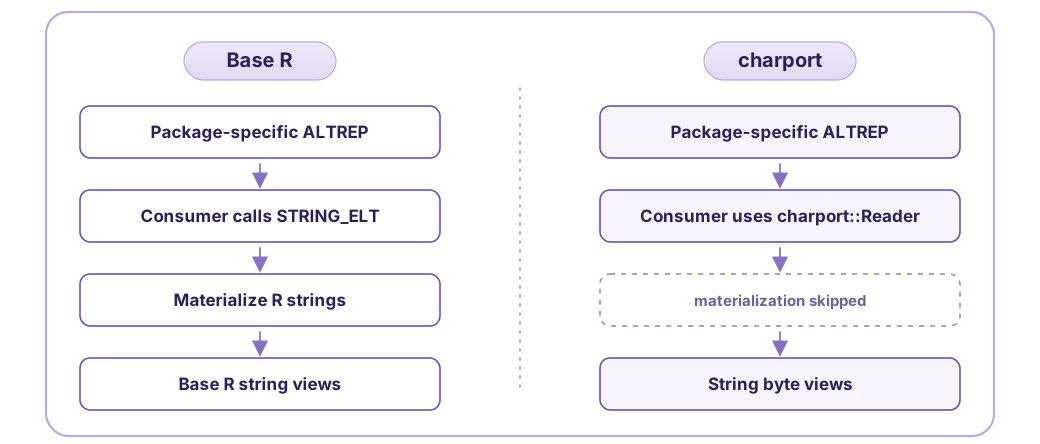
Both start from an ALTREP vector from a producer package. On the base
R path, the consumer accesses strings through the R API; work is done to
materialize ALTREP strings into ordinary R strings. On the
charport path, the consumer opens a
charport::Reader on the same vector, and the producer hands
back a read-only view of the string data. The extra materialization work
can be avoided.
The benchmark below runs these paths on the enwik8
dataset, the first 1E8 bytes of Wikipedia. The benchmark asks: how much
is avoiding materialization worth?
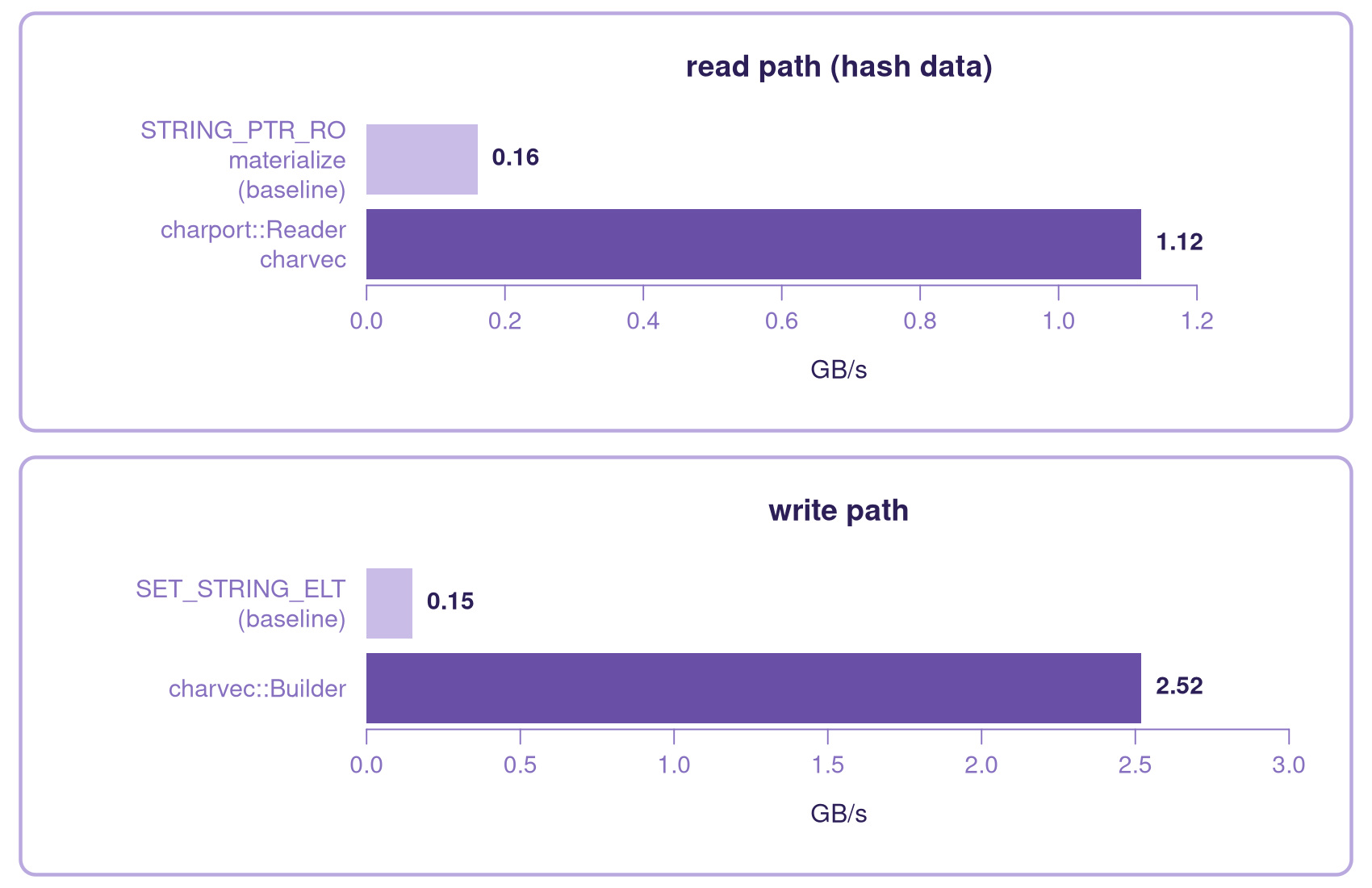
These measurements show order-of-magnitude performance improvements are possible by working with ALTREP strings end-to-end. The figure shows the serial case. Because ALTREP classes do not rely on R memory, parallel construction and access can improve on these numbers.
charport acts as a small broker for ALTREP strings:
register_altrep.charport::Reader.The interface is intended to be minimal and safe. It is available for both C++ and C.
charvec: a
reference ALTREP character vectorcharport also includes charvec, which
stores string data in large data blocks.
To R, a charvec behaves like an ordinary character
vector. In compiled code, a charvec can be constructed
serially or across multiple worker threads, then read through
charport::Reader without materialization.
It serves as both a reference implementation and an efficient general-purpose class.
Package authors can use charport from either side of the
interface.
The developer guide covers registration, string access, fallback
behavior, pointer lifetime, thread safety, and the charvec
builder.
utils::vignette(package = "charport").